

A website is not a book. Google and Gemini do not read every page from start to finish — they sample, they follow internal links, and they make rapid judgments about what a site is about and which pages can be trusted on which topics.
Most business websites fail this test. Their pages exist in isolation: a homepage, a few service pages, some blog posts linked from nowhere, and an FAQ page that Google has never indexed. There is no hierarchy, no topic clustering, no signal to search engines that says this site is the authority on this subject.
A content silo fixes that problem structurally.
What Is a Content Silo?
A content silo is a way of organizing a website into clearly defined topic clusters, each with a hub page (the main topic) and child pages (subtopics and supporting content). Every page in a silo links to its hub, and the hub links back to all its children. Nothing links outside its silo without a purpose.
The result is a site that communicates a clear message to search engines: we are a comprehensive authority on these specific topics, and here is the evidence.
This matters for two reasons:
-
Google rewards sites that demonstrate topical depth — covering a subject thoroughly and consistently, not scattering keywords across unrelated pages.
-
Gemini (Google's AI) is constrained by processing tokens — it cannot read everything. It prioritizes sites where the architecture itself declares what the content is about, because that reduces the parsing work. A well-structured silo is like giving Gemini a table of contents before it even starts reading.
The Anatomy of a Silo
Every silo has three layers:
| Layer | Role | Example |
|---|---|---|
| Pillar / Homepage | Establishes the site's overall authority | toporganicleads.com |
| Hub page | Owns a core topic | /lead-generation/seo-geo |
| Child pages | Cover subtopics in depth | /lead-generation/seo/content-development |
The internal links flow in both directions: hub → children (to distribute authority downward) and children → hub (to reinforce the hub's authority upward). Cross-silo linking is allowed sparingly, only when genuinely relevant.
What to avoid:
- Blog posts published with no internal links pointing to them (orphan pages)
- Service pages that link only to the homepage, not to related service content
- Navigation menus that link everything to everything — this dilutes the signal
Real Example: TuanLeLaw.com
TuanLeLaw.com is the website of Tuan Le, an immigration and family law attorney. When we began working on the site, the structure was typical of most law firm websites: a handful of top-level service pages, a blog with articles spread across unrelated topics, and no internal linking strategy.
Before: Flat Structure
The old site had all its pages at roughly the same level — immigration sub-topics, blog articles, and utility pages (FAQ, contact, testimonials) mixed together with no hierarchy. Google had no clear signal about which topic the site was most authoritative on, or which pages were the most important.
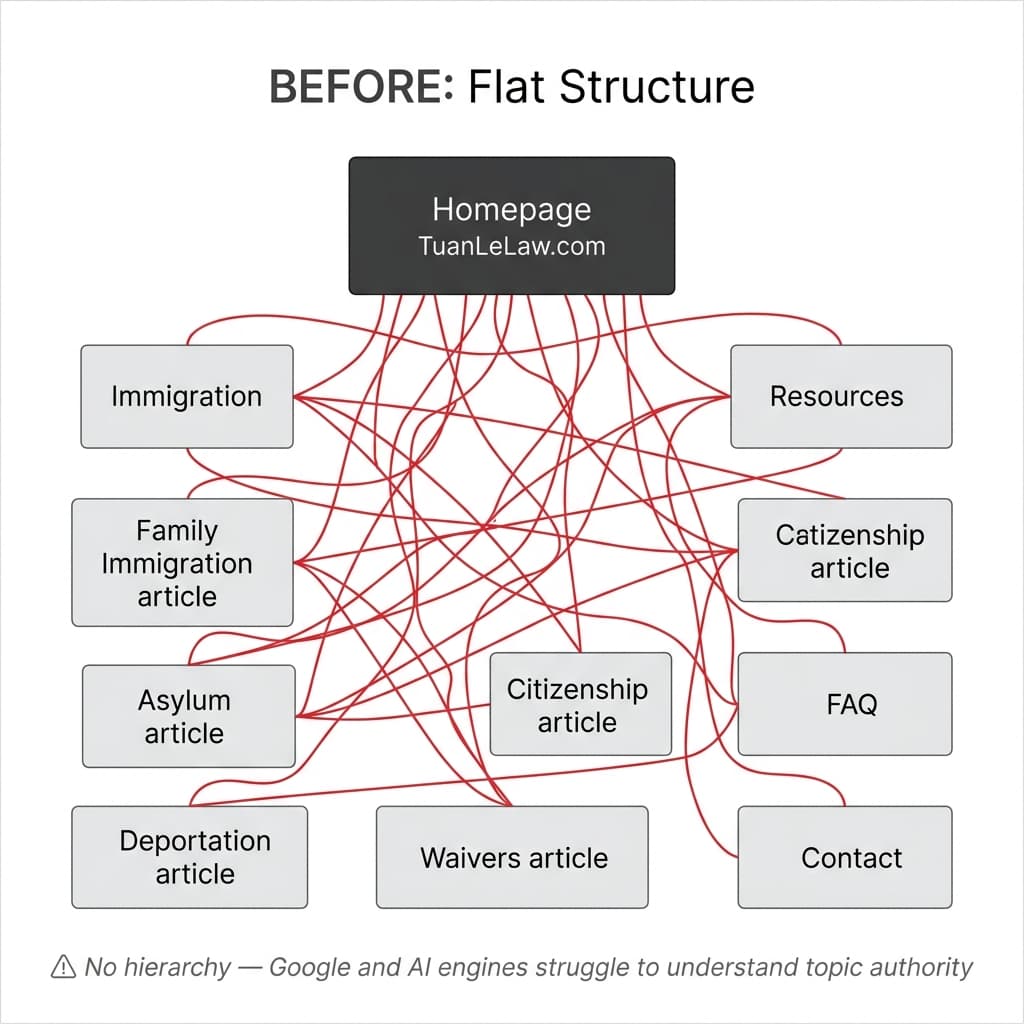
The consequences were predictable:
- Keyword cannibalization between service pages (multiple pages competing for the same query)
- Blog articles with no connection to service pages, delivering traffic that never converted
- Google treating the site as a general legal information resource rather than an expert in immigration law
After: Silo Structure
We restructured the site around a single, deep Immigration Law silo — because that is the only practice area Tuan Le offers, and going deep on one topic builds far more authority than spreading thin across many.
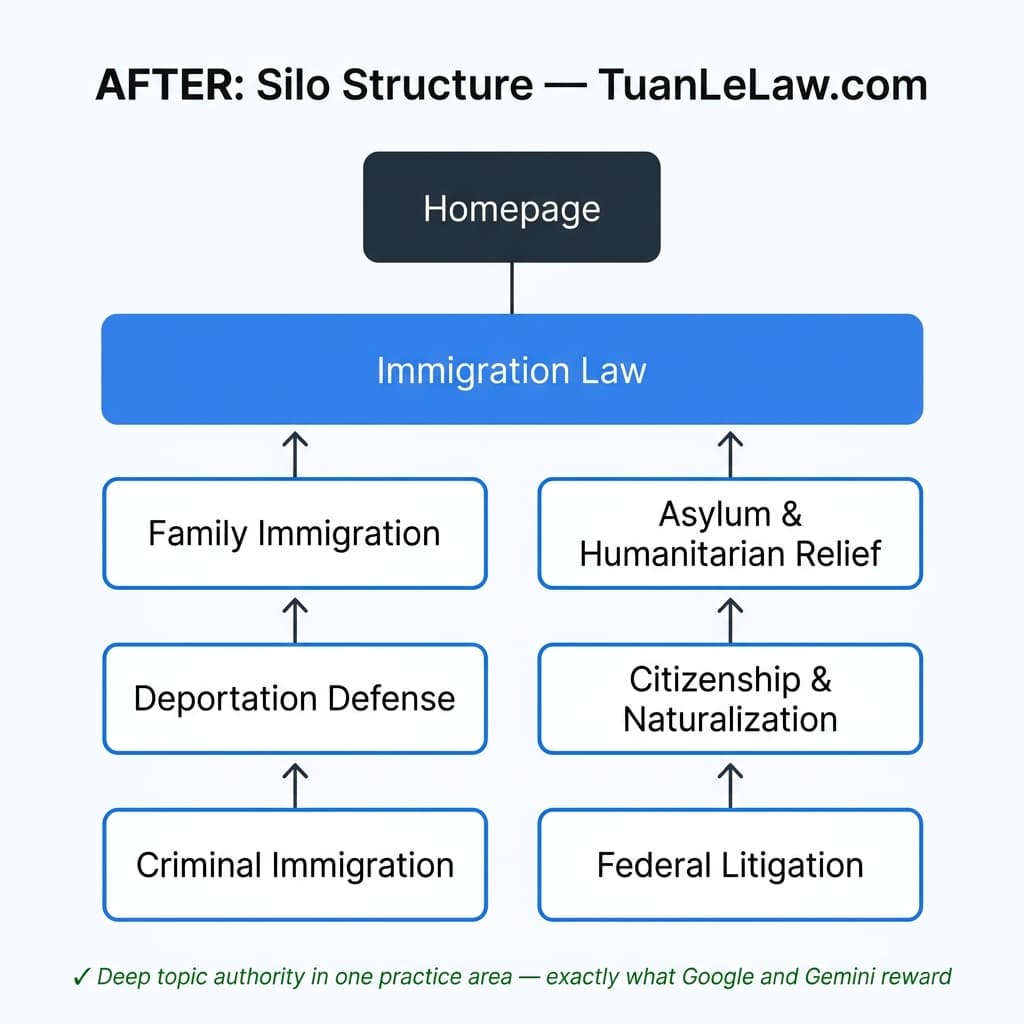
The single silo — Immigration Law (hub), with six child pages covering every sub-practice:
- Family-based Immigration
- Asylum & Humanitarian Relief
- Deportation Defense
- Citizenship & Naturalization
- Criminal Immigration
- Federal Litigation
Every article on immigration topics now links back to the Immigration Law hub, reinforcing it as the definitive authority page. The hub links down to each child. All new content — FAQ answers, blog articles, resource guides — is published under the appropriate child page, never floating loose.
What changed for Google and Gemini:
- The Immigration Law hub began ranking for broader, higher-competition terms like "immigration attorney" and "deportation lawyer"
- Child pages ranked for specific long-tail queries that were previously invisible to Google
- Gemini began citing the Immigration Law hub when answering questions about asylum and deportation defense — because the site now looked like a dedicated expert resource, not a general directory
- Focusing the entire site on one practice area meant every new page added compounds the authority of the hub, rather than diluting it across unrelated topics
How to Build a Silo for Your Business
Step 1: Map your core topics
List every service or product category you offer. These become your hub pages. Aim for three to six silos — more than that and the authority signal becomes diluted.
Step 2: List the subtopics under each hub
For each hub, list every specific service variation, location, customer type, or frequently asked question. These become your child pages. A good silo has at least three to five child pages per hub.
Step 3: Audit your existing content
Which pages already exist? Do they belong in a silo? Are there orphan pages — content that has no internal links pointing to it? Map everything before you restructure.
Step 4: Build bidirectional internal links
- Every child page must link back to its hub
- Every hub must link to all its child pages
- Hubs may link to other hubs when the topics are genuinely related
- The homepage links to all hubs
Step 5: Match URLs to the silo hierarchy
Your URL structure should mirror the silo hierarchy:
/immigration/family-immigration/       ← child of /immigration/
/immigration/asylum-defense/           ← child of /immigration/
/immigration/deportation-defense/      ← child of /immigration/
/resources/case-studies/               ← child of /resources/
Google reads URL paths as part of its relevance signal. A clean, hierarchical URL structure reinforces the silo architecture.
The Silo and GEO Connection
AI engines like Gemini operate under token budget constraints. When crawling a site to synthesize an answer, Gemini allocates a fixed amount of processing to each domain. A silo-structured site uses that budget efficiently: the architecture itself communicates the hierarchy, so Gemini can allocate tokens to reading the content rather than inferring the structure.
A flat, disorganized site forces Gemini to spend its budget figuring out what the site is about — and often gives up before reaching the most valuable pages.
This is not a minor technical detail. In our work with clients, the difference between a flat site and a properly structured silo has been the difference between never appearing in AI Overviews and being cited consistently for high-intent queries.
Final Thoughts
A silo structure is not a design choice. It is a strategic commitment: every page you publish either reinforces your authority on a topic or dilutes it. Done correctly, a silo compounds in value over time — each new child page strengthens the hub, and a stronger hub lifts all its children.
For businesses competing in Google's AI-driven search landscape in 2026, the structure of your site is as important as the quality of your content. Both need to be excellent. Neither alone is enough.
Learn more about our SEO/GEO strategy | See how our pay-per-sale model works.