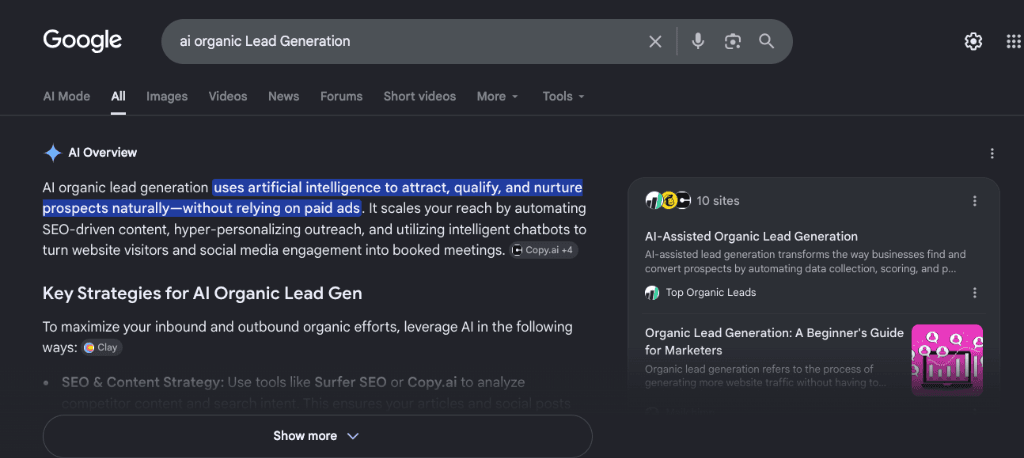
AI can improve organic lead generation when it is used for research, planning, analysis, and follow-up speed, with people responsible for accuracy and customer relationships. It does not create leads on its own, and it cannot make weak content, a slow website, or a neglected Google Business Profile convert. For local businesses, the biggest wins usually come from combining AI-assisted workflows with strong local SEO, clear service pages, fast sites, and good lead tracking.
This guide explains what organic lead generation is, where AI fits in 2026, which tasks are worth automating, and how to avoid the mistakes that cost businesses rankings and trust.
What Is Organic Lead Generation?
Organic lead generation means attracting potential customers without paying per click or impression. The main channels are:
- Search engine optimization (SEO): service pages, location pages, and helpful articles that rank in Google.
- Local search: your Google Business Profile, map pack visibility, and reviews.
- Content marketing: guides, case studies, videos, and FAQs that answer buyer questions.
- Social media and email: staying visible and following up with people who already know you.
- Referrals and word of mouth: still a top source for many service businesses.
Organic traffic does not carry a per-click fee, but it is not free. It costs time, expertise, and consistent work. The payoff is that a page that ranks can keep producing calls for a long time, while paid campaigns stop when the budget stops. Many businesses use both; our comparison of pay-per-lead SEO and Google Ads walks through the trade-offs.
How Search Changed: AI Overviews and AI Mode
Google now shows AI-generated summaries (AI Overviews) on many searches and offers a conversational AI Mode. Google's documentation for site owners says the same SEO basics still apply to these features: pages must be indexed and eligible to appear with a snippet, and content should be helpful and reliable. There is no special markup needed to be included.
What this means for lead generation:
- Informational searches may produce fewer clicks, since the answer is shown on the results page.
- Local and commercial searches ("roofer near me," "commercial hood cleaning," "family law attorney in Irvine") still depend on map results, reviews, and service pages.
- Being a clear, trustworthy source helps you get cited and recognized, but the conversion still happens on your site or phone line.
So the goal is not "rank for everything." It is to be the obvious choice for customers who are ready to hire. See zero-click searches and SEO strategies for more on adapting.
Why AI Matters for Organic Lead Generation
AI is most useful where work is repetitive, data-heavy, or time-sensitive:
- Speed: summarizing research, clustering keywords, and drafting outlines in minutes.
- Pattern spotting: finding which pages, queries, or sources are producing leads.
- Consistency: helping small teams keep up with publishing, reporting, and follow-ups.
- Responsiveness: answering simple questions and capturing contact details outside business hours.
AI is least useful where trust and expertise matter: setting pricing, making promises, giving legal or medical guidance, or representing your real work. Those need a person.
AI-Driven Strategies That Work
1. AI-assisted content planning
Use AI to find questions customers ask, group related topics into clusters, and create briefs. Then add what only your business knows: how you price jobs, what affects timelines, local codes and conditions, before and after photos, and mistakes you see customers make.
Pages that clearly show real experience are harder for competitors to copy. Plan topics as connected clusters so each page supports the others; see content clusters strategy.
A caution: publishing large volumes of lightly edited AI text is the quickest way to run into Google's scaled content abuse policy. Publish fewer, better pages.
2. Better local SEO and Business Profile management
For local businesses, a lot of organic leads come from the map pack. AI can help by:
- summarizing review themes so you know what customers praise and complain about,
- drafting reply options for each review, which a person edits and posts,
- spotting inconsistent business details across directories,
- suggesting questions and topics for Business Profile posts.
Never generate fake reviews or ask AI to invent testimonials. Our resources on Google Business Profile explain what to maintain.
3. Faster follow-up and lead qualification
Leads go cold quickly. AI can help you respond sooner with:
- automatic acknowledgements for form submissions,
- call transcription and tagging, so you can see which calls were real opportunities and which were spam, wrong numbers, or vendor pitches,
- scoring rules that put the most promising inquiries at the top of the queue.
This last point matters more than most people realize. If your reports count every call and form as a lead, your numbers are inflated and your decisions suffer. Reviewing verified leads is the cleanest way to know what is working. See how we think about conversion rate optimization.
4. Personalization with guardrails
Email platforms can suggest send times and subject lines, and segment contacts by behavior. Used well, that makes follow-up more relevant. Keep it simple for local businesses: a quick quote reminder, a seasonal maintenance note, or a review request after a completed job often does more than a complicated automation.
5. Social media and video support
AI can help brainstorm ideas, repurpose a long article into short posts, and write captions or video descriptions. Quality still depends on real footage and real people. Short videos of finished jobs, quick tips from your crew, or answers to common questions tend to feel more trustworthy than polished but generic content.
6. Analytics and reporting
AI summaries of Search Console, analytics, and call data can show which pages lose traffic, which queries are rising, and where visitors drop off. Ask for a summary, then verify the numbers in the original tool before acting.
Tool Categories to Consider
Instead of chasing a "best AI tool" list that changes every few months, think in categories and match them to a real need:
| Need | Examples of tool types | What to check |
|---|---|---|
| Content research and optimization | Surfer and similar SEO content platforms | Do recommendations match real search results for your market? |
| Email follow-up | Mailchimp and other email platforms | Can you segment by service or location, and is consent tracked? |
| Social scheduling | Hootsuite and similar tools | Will your team actually use it weekly? |
| CRM and lead management | HubSpot and other CRMs | Does it connect to call tracking and forms so leads are verified? |
| Call tracking and transcription | Call tracking platforms | Can you tag real leads and filter spam? |
Features and pricing for all of these change often, so check each vendor's current page before buying. Pick one or two tools that solve a real bottleneck instead of stacking subscriptions.
Ethics, Privacy, and Compliance
AI use in lead generation involves personal data, so handle it carefully:
- Do not paste customer information into public AI tools unless your agreement and policies allow it.
- Follow privacy laws that apply to your customers, such as the California Consumer Privacy Act, and email rules such as CAN-SPAM. If you serve people in the EU, GDPR also applies.
- Be transparent about call recording and data collection, and get consent where required.
- Review outputs for bias and errors. AI can make assumptions about people or places that are wrong or unfair.
- Never fabricate reviews, credentials, case studies, or photos.
Trust is the basis of organic lead generation. One shortcut that damages it can cost far more than it saves.
A Simple 30-Day Plan for Local Businesses
- Week 1: Get the basics right. Confirm your Business Profile details, fix site speed issues, and make sure phone and form tracking work.
- Week 2: Plan content. Use AI to list customer questions and group them by service and location. Choose a handful that match buying intent.
- Week 3: Create and edit. Draft with AI help if you like, then have an expert add real details and edit for voice. Add original photos and clear calls to action.
- Week 4: Measure and follow up. Review verified leads, response times, and which pages produce calls. Adjust.
Repeat monthly. Small, steady improvements beat sudden, large content dumps.
Final Thoughts
AI is a useful multiplier for organic lead generation, not a replacement for strategy, expertise, or customer care. The businesses that benefit most use it to move faster on research and follow-up, while keeping humans in charge of facts, local knowledge, and relationships.
If you want a partner that is paid on results, learn more about our pay-per-lead SEO model or contact us to discuss your market.
FAQs
Can AI generate leads for me automatically?
No. AI can make research, follow-up, and analysis faster, but leads come from being visible and trusted when people search. That takes useful pages, a strong local presence, and a site that converts.
Is it safe to publish AI-written content?
It can be, if the content is accurate, helpful, and reviewed by a person who knows the subject. Mass-produced, unedited AI pages can violate Google's spam policies.
How do AI Overviews affect local lead generation?
They reduce clicks on some informational searches, but local and high-intent searches still rely on map results, reviews, and service pages. Focus on being the clear choice for people ready to hire.
Which AI task should a small business try first?
Customer-question research and review analysis are low-risk starting points. Then look at faster lead follow-up and call tagging.
How do I know if AI is actually helping?
Track verified leads, cost per verified lead, response time, and the pages that produce calls. Traffic alone does not tell you.